
Sunday message · The Book of Matthew series
Listen to the message
Message Summary
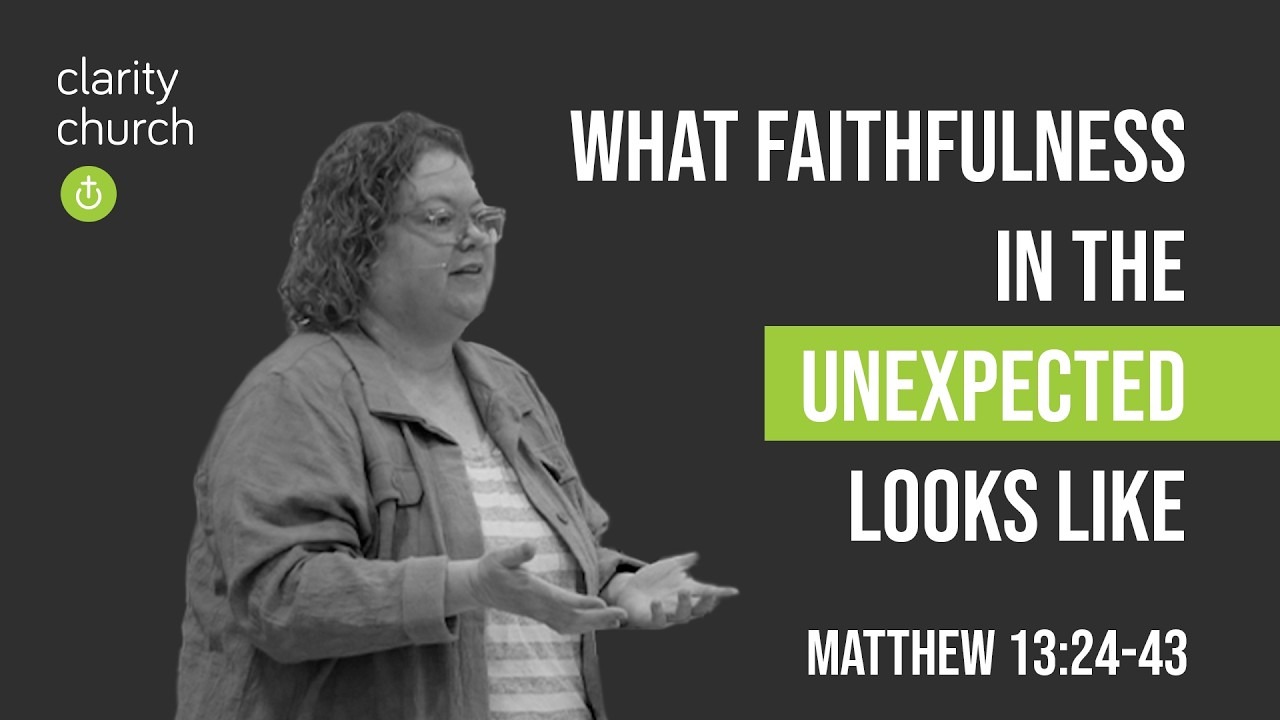
Continuing the church’s study of Matthew 13, Danielle Allen explores three parables of the kingdom in verses 24–43. She once left a church ministry job, after two years of sensing God’s nudge, to start a coaching business she expected to grow huge. It has stayed small, with a faithful core. God has shown up, just not as she expected. Jesus’ hearers, too, expected the kingdom to come with power and overthrow Rome, but got a rabbi telling stories about everyday life, and wondered why it had not triumphed more openly. Her main point: when it comes to the kingdom of heaven, expect the unexpected, because God’s ways are higher than ours (Isaiah 55:8–9).
In the first parable, a man sows good seed, but an enemy sows weeds among the wheat at night. The weeds were darnel, a poisonous look-alike, so the owner lets both grow until harvest. It is the only one of the three Jesus explains: the sower is the Son of Man, the field is the world rather than the church, and the harvest is the judgment at the end of the age. Like the master, we can do everything right and still see mixed results. Yet everything is going as planned, Danielle says; God has not taken a nap. It is not our job to sort wheat from weeds but to sow good seed faithfully, remembering Augustine’s words that those who are weeds today may be wheat tomorrow.
The mustard seed, about two millimeters across and the smallest seed in Palestine, grows into a tree ten to twenty feet tall, a picture of small beginnings rather than greatness. Danielle, who did not grow up in a Christian home, traces the seeds others planted: neighborhood kids, a friend of her mother’s, a high school friend and a coworker. Many never saw her come to faith in college. As Jennie Allen, founder of the IF:Gathering, puts it, our greatest ministry happens in everyday conversations around our kitchen tables. Paul reminds the Corinthians that he planted, Apollos watered, but God made it grow (1 Corinthians 3:5–9).
Yeast works differently. A small piece of fermented dough kneaded into about sixty pounds of flour permeates the whole batch, like the sourdough starter Danielle remembers her mother keeping in a mason jar. The mustard seed grows, but yeast permeates, and believers are called to be that yeast, mixing with people who are not yet “yeastified.” The kingdom is clandestine and often unexpected, small beginnings lead to maturity, and our job is to be faithful and leave the results to God.
Danielle closes with a story from her seminary years. Fifty women signed up for a Bible study she taught, and she pictured herself as the next Beth Moore. For the summer study, five signed up. A devotional phrase convicted her: “Tend the garden God gives you.” That summer, a woman who was not a Christian came to faith. God has given each of us a garden, Danielle says, and invites us to tend it through small beginnings, trusting that he does the work.
More in this series
Matthew 19:13-30: Why What You Consider a Strength May Be Your Biggest Spiritual Blindspot
Matthew 19:7-12: Who Gets the Final Word? (Jesus on Divorce, Singleness, Sexuality, Surrender, and the Gospel)
Matthew 19:1-6: Jesus on Marriage, Sexuality, and the Question Nobody Wants to Ask
Matthew 18:21-35: Jesus and the Difficult Truth about Forgiveness
Matthew 17:1-21: From the Mountaintop to Everyday
Matthew 16:13-28: When the Problem is Me