A devotional is a short Bible reading, usually a passage of Scripture, a brief reflection and a prayer, that helps you spend a few minutes with God. The word also names the habit itself, often called “devotions” or a “quiet time”: a regular time you set aside to read the Bible, think about what it says and pray.
The point isn’t to check a religious box. It’s to spend time with God. The Bible is how God speaks to us, and prayer is how we answer.
Your word is a lamp for my feet and a light on my path.
Psalm 119:105 (CSB)
What does “devotional” mean?
“Devotional” comes from devotion: love and loyalty given to someone. As a describing word it means “used in worship or prayer,” as in devotional music or a devotional reading. As a noun, a devotional is the reading itself, or the daily time you spend with God using one. In everyday church talk, “doing a devotional” or “having devotions” simply means taking a few minutes to read the Bible and pray.
You’ll hear the word in a few other ways, too. In church, a “devotion” or “devotional” can also be a short talk that opens a meeting, a youth group or a Bible study: a few verses, a brief thought and a prayer. “Devotional time” or “morning devotions” is the part of the day you set aside for it. And “devotion” on its own still means love and loyalty, as in being devoted to God.
What do you do during a devotional?
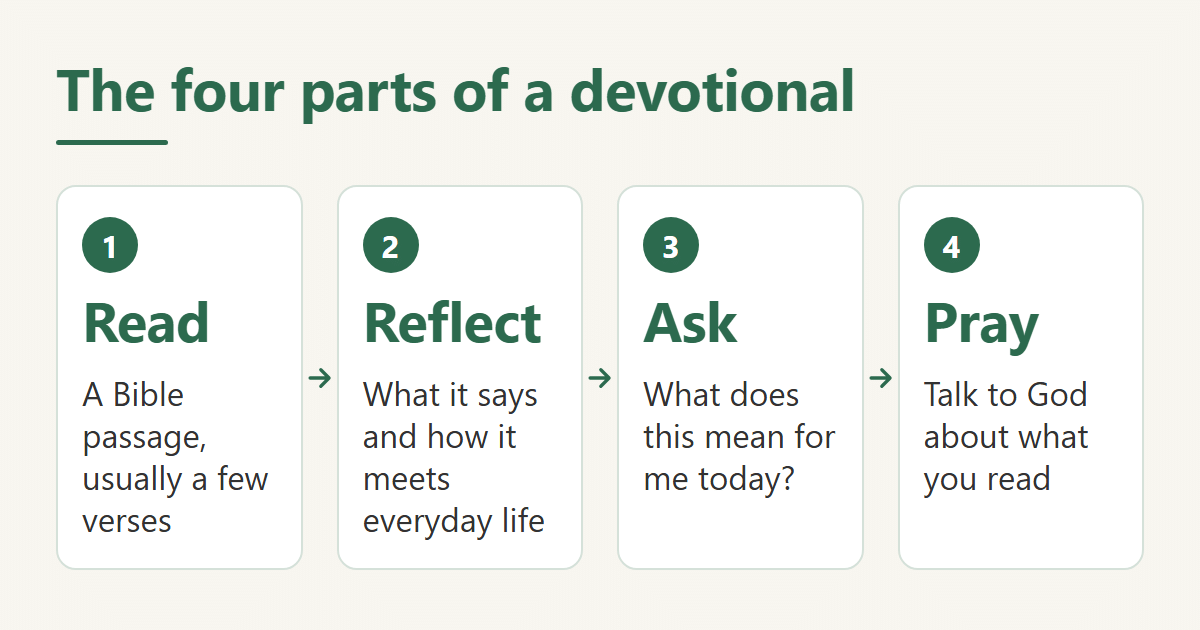
Most devotionals, whether you use a book or just your Bible, have four parts:
- A Bible passage. Usually a few verses, sometimes a chapter. Short is fine.
- A reflection. A few paragraphs that explain the passage and connect it to everyday life.
- A question to think about. Something that asks, “What does this mean for me today?”
- A prayer. A way to talk to God about what you just read.
An example of a short devotional
Here is what a five-minute devotional can look like, using the four parts above.
Read.
Because of the LORD’s faithful love we do not perish, for his mercies never end. They are new every morning; great is your faithfulness!
Lamentations 3:22–23 (CSB)
Reflect. These words were written after Jerusalem had fallen. Nothing around the writer looked hopeful, yet he stopped and remembered who God is. God’s love doesn’t run out overnight. Yesterday’s failures and today’s worries don’t use up His mercy. Every morning comes with a fresh supply. The phrase “faithful love” translates the Hebrew word chesed, God’s loyal, covenant love, His devotion to His people. A daily devotional is a small way of answering His devotion to you.
Ask. What from yesterday do I need to leave with God this morning?
Pray. Lord, thank You that Your mercies are new this morning. I bring You what I’m carrying today. Help me trust Your faithfulness more than my feelings. Amen.
Devotional or Bible study?
A devotional is short and personal. It asks what a passage means for your heart and your day. Bible study digs into history, context and the original languages, and usually takes longer. Both are good, and they help each other. When you want to go deeper, our Bible Study Tools page has free commentaries and study guides, and How to Study the Bible walks through a simple method for beginners.
| Devotional | Bible study | |
|---|---|---|
| Time | 10 to 15 minutes | 30 to 60 minutes or more |
| Goal | Spend time with God and carry one thought into the day | Understand what a passage meant then and means now |
| How much you read | A few verses | A chapter or a whole book, in context |
| What you use | A Bible, and a devotional guide if you like | A Bible, notes and study helps |
| Good for | A daily habit | Going deeper once or twice a week |
Are devotions in the Bible?
The word “devotional” isn’t in the Bible, but the habit behind it runs all through it. Psalm 1 pictures a person whose “delight is in the LORD’s instruction, and he meditates on it day and night” (Psalm 1:2). David prayed, “In the morning, LORD, you hear my voice” (Psalm 5:3). Daniel knelt to pray and give thanks “three times a day” (Daniel 6:10), and Jesus got up before dawn to pray (Mark 1:35).
The first Christians “devoted themselves to the apostles’ teaching, to the fellowship, to the breaking of bread, and to prayer” (Acts 2:42). That is the heart of the word: a devotional is one small, daily way of being devoted to God.
Scripture doesn’t set a time of day, a length or a format for devotions. It does call us to keep God’s word close and to “pray constantly” (1 Thessalonians 5:17). A daily devotional is a simple way to do both. If you miss a morning, you haven’t broken a rule; you’ve missed a good conversation, and tomorrow is a new one.
How to start a daily devotional
- Pick a time. Morning works for many people because the day hasn’t gotten away from them yet. Jesus Himself made time early in the day to pray. Lunch or bedtime work too. The best time is one you can keep.
- Pick a place. A chair by a window, the kitchen table, your car before work. The same place at the same time turns it into a habit.
- Start with ten minutes. Five minutes to read, five to think and pray. You can always go longer.
- Choose a plan. Read through one book of the Bible, like Mark or Philippians, try a psalm a day, or follow a devotional series. A plan saves you from wondering what to read each morning. Or start with the seven-day plan below.
- Use a simple pattern. One easy pattern is SOAP: read the Scripture, write one Observation, one Application for today and a short Prayer.
- Write one sentence down. Use a notebook or the notes app on your phone. Looking back after a month is encouraging.
- Don’t quit when you miss a day. Everyone misses. Just start again tomorrow.
Very early in the morning, while it was still dark, he got up, went out, and made his way to a deserted place; and there he was praying.
Mark 1:35 (CSB)
A 7-day devotional plan to get started
Not sure where to begin? Try this one-week plan. Each day, read the passage, sit with the question for a minute, and finish with a short prayer in your own words. Ten minutes is enough.
- Day 1: Psalm 1. What does a life rooted in God’s word look like, and where do I want to grow?
- Day 2: Psalm 23. Where do I need the Shepherd’s care today?
- Day 3: Mark 1:29–39. After a long, busy day, Jesus still made time to pray. What could I move to make room for God?
- Day 4: Matthew 6:5–15. Pray the Lord’s Prayer slowly, one line at a time. Which line do I need most today?
- Day 5: John 15:1–11. What would it look like to remain in Jesus today?
- Day 6: Philippians 4:4–9. What worry can I turn into a prayer right now?
- Day 7: Romans 8:31–39. Which of these promises do I need to carry into next week?
When the week is done, keep going: read Mark one chapter a day, or take a psalm a day.
Types of devotionals
- Daily devotional books. A reading for each day of the year, often by a single author.
- Apps and email devotionals. The same idea, delivered to your phone each morning.
- Devotional Bibles. A complete Bible with short devotional readings or notes printed alongside the text, so the passage and the reflection are on the same page.
- Family devotionals. Short readings, questions and prayers for parents and kids together. See our family devotionals.
- Seasonal devotionals. Readings for a season of the church year, like our Advent devotional in December.
- Topical devotionals. A few days on one subject, such as fear, forgiveness or prayer.
- Your own. Just your Bible, a notebook and the SOAP pattern above.
Common questions
A simple devotional is a short passage, one thought, one question and a prayer. For example, read Psalm 23, notice one thing it says about God, ask what that means for your day, and thank Him for it in a sentence or two.
You read a short part of the Bible, think about what it says and talk with God about it. Many people also write down one sentence to carry into the day.
Pick a time and a place, open to a short passage such as a psalm or a few verses from one of the Gospels, and ask God to help you understand it. Ten minutes a day is enough to begin.
The Bible is God’s word itself. A devotional is a short guide that helps you read part of the Bible, think about it and pray, so it points you to Scripture and never replaces it.
Devotions, sometimes called a quiet time, are a short, regular time set aside to read the Bible, think about what it says and pray. The word devotional also describes the books, apps and posts that guide that time, usually a Bible passage, a few paragraphs of reflection and a prayer. The point isn’t to check a religious box; it’s to spend time with God.
A daily devotional is a reading meant for each day: usually a book or app with one dated entry for every day of the year, or a reading plan you follow on your own. Each entry pairs a short Bible passage with a reflection and a prayer. The daily rhythm is the point. A few minutes with God, morning after morning, adds up to a habit that shapes you.
Pick a regular time and place, start with about ten minutes, and follow a simple plan: read a short Bible passage, think about what it means for your day, and pray. A plan, such as reading through Mark or Philippians or a psalm a day, saves you from wondering what to read each morning. If you miss a day, just start again tomorrow.
Ten to fifteen minutes is plenty. The Bible passage can be a few verses or a short chapter, and a written devotional reading is usually a page or less, something you can read in about five minutes. If you’re writing one, aim for one clear thought rather than many. A short time you keep is better than a long time you skip.
Pick a translation you understand. Easy-to-read options include the NIV, the CSB and the NLT, and the verses on this page are from the Christian Standard Bible (CSB). A Bible app works too.
That’s normal, especially in the Old Testament. Read it again, look at the verses just before and after, and write your question down. Then ask someone. A small group is a great place for that; see our Church Groups to find one.
Yes, and they don’t need to be long. Read a short Bible story, ask one question and pray together. Our Bible Resources for Parents list has picks for every age.
SOAP is a simple four-step pattern for a daily devotional: read the Scripture, write down one Observation about the passage, one Application for your life today, and a short Prayer. Writing even one sentence for each step keeps your quiet time focused, and looking back over a month of notes is encouraging.
A devotional book is a collection of short readings meant to guide a daily time with God. Most entries follow the same four parts: a Bible passage, a few paragraphs that explain it and connect it to everyday life, a question that asks what it means for you today, and a prayer. Apps and online devotionals work the same way.
Build it on the four parts most devotionals share: choose a short Bible passage, write a few paragraphs that explain it and connect it to everyday life, add one question that asks what it means for the reader today, and close with a short prayer. Keep it brief; ten to fifteen minutes is plenty for a reader’s daily time with God.
A devotional message is a short reflection on a Bible passage: usually a few paragraphs that explain the verses and connect them to everyday life, followed by a question to think about and a prayer. It’s shorter and more personal than a Bible study, and it asks what the passage means for your heart and your day.
Mostly time and aim. A devotional takes ten or fifteen minutes and asks what God is saying to you today. Bible study usually takes longer, often with a group, a commentary or our Bible Study Tools, and asks what a passage meant to its first readers and how it fits the rest of Scripture. Most Christians do both, and each makes the other richer.
Where to start
- Browse our devotionals, short reflections on Scripture from Clarity Church.
- Read along with our Advent devotional each December.
- Grow in prayer with our Prayer Resources.
- Wondering whether the Bible can be trusted at all? Start with Can the Bible Be Trusted?
We’d love to see you on Sunday. Clarity Church meets Sundays at 10am at Edinbrook Elementary, 8925 Zane Ave N in Brooklyn Park, and the cafe opens at 9:45. Plan your visit and come as you are.
Scripture quotations are from the Christian Standard Bible®, Copyright © 2017 by Holman Bible Publishers. Used by permission. Christian Standard Bible® and CSB® are federally registered trademarks of Holman Bible Publishers.